
Your best salesperson is updating the CRM. Your operations manager is chasing missing documents. Your technical specialist is copying details between systems while customers wait for decisions only that specialist can make.
When this happens, another local hire may add capacity. It may also add another person to the same congested process.
A different option is to redesign how work moves through the business: Australian staff handling the responsibilities suited to their expertise and location, Filipino virtual assistants owning defined operational workflows, and AI or conventional automation assisting with suitable steps.
This structure can create room to grow. Its success depends on clear responsibilities, capable people and measured improvements—not simply moving work offshore or buying AI subscriptions.
Start with the work, then design the team
Before writing a job advertisement, follow one customer request from arrival to completion. List every handover, copied field, missing document and decision.
Then separate the process into three kinds of work:
- Judgement and accountability: commercial decisions, complex complaints, technical review and approvals.
- Operational coordination: collecting information, maintaining records, scheduling, tracking progress and resolving routine issues.
- Repeatable processing: moving data, creating reminders, applying fixed rules and drafting material from approved information.
These are starting categories, not permanent limits on anyone's career. A qualified Filipino specialist may own complex work. An Australian administrator may lead process improvement. Allocate responsibilities according to demonstrated capability, permissions and any applicable professional requirements.
For suitable processing tasks, use conventional automation when the rules are fixed. Consider AI where language or document interpretation is involved, with checks matched to the consequences of an error.
Build around an outcome someone owns
Consider a business preparing customer proposals. An Australian sales lead might own the offer and customer relationship. A Filipino coordinator might own the information-gathering queue. An AI tool might summarise approved material and prepare a draft for review.
| Work | Example owner | Completion standard |
|---|---|---|
| Gather customer information | Filipino operations coordinator | Required information checked; gaps recorded |
| Prepare a draft summary | AI tool, supervised by the coordinator | Summary matches the source documents |
| Decide scope and price | Authorised sales or technical lead | Proposal approved within the person's authority |
| Send and track follow-up | Assigned customer-facing team member | Correct version sent; next action recorded |
| Resolve unusual requests | Named process owner | Exception decided and the customer updated |
The whole process still needs one accountable owner. Otherwise, everyone can finish their step while the customer receives nothing.
For a solar business, this might mean a coordinator prepares the project file and requests missing information while appropriately qualified people retain design review and required approvals. Software can support the file; it does not acquire professional responsibility by producing a convincing answer.
What the productivity evidence actually shows
There is credible evidence that AI can help people work more effectively. There is also a clear reason to test individual uses.
A published study of 5,172 customer-support agents found a 15% average increase in issues resolved per hour with AI assistance. Benefits varied across workers. It examined one company and one occupation, so it cannot establish the return for every business. Read the study in the Quarterly Journal of Economics.
An experiment with 758 consultants found that AI users completed suitable tasks 25.1% more quickly on average and finished 12.2% more tasks. On a task outside the system's capabilities, AI use reduced correctness. That makes task selection and review central to implementation. Read the published consulting study.
In a separate experiment involving professional writing assignments, average completion time fell 40% and assessed quality rose 18%. These were specific assignments, rather than the full range of work required to operate a company. Read the Science study.
None of these studies proves that combining Filipino VAs and AI produces 100 times the output of a locally staffed Australian company. They support a practical proposition: well-chosen tools can improve particular activities, and management must convert those gains into useful business results.
Measure the whole process, including review
Imagine a hypothetical company processing 400 information packs each week. A manual checking step takes eight minutes per pack: about 53 hours in total.
After improving the intake form, adding AI assistance and training a coordinator, suppose the same step takes three minutes, including human verification. That is 20 hours, freeing roughly 33 hours at that step. If additional weekly monitoring and process maintenance take eight hours, the net saving falls to about 25 hours.
This is an illustration, not a Nexus client result or a forecast. It assumes comparable quality, task complexity and volume.
Even under those assumptions, the company has not automatically increased revenue. If approvals are already the bottleneck, completed proposals may barely change. The next improvement must address that constraint.
Track customer waiting time, accepted jobs completed, first-pass accuracy, rework, escalation volume and the full cost per accepted result. Include software, training and supervision. A faster draft that takes longer to correct is not progress.
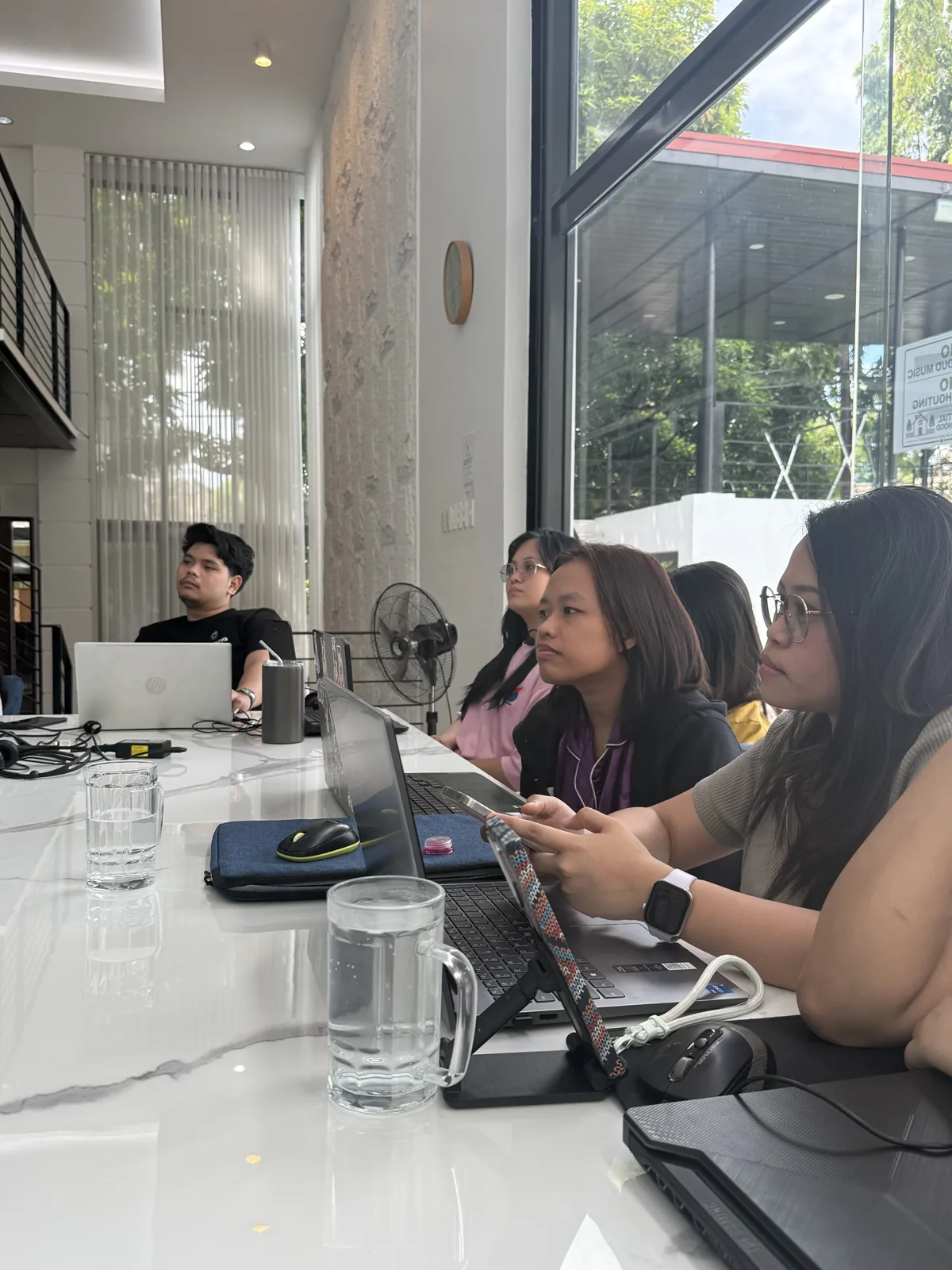
Give Filipino team members ownership and support
A vague instruction to “help with admin” creates avoidable dependence on the manager. A defined responsibility—such as keeping every active project file ready for review—gives the team member a useful outcome to manage.
Provide examples of good work, access to current procedures, a clear escalation route and time for coaching. Invite the people doing the work to improve the process. They often encounter recurring exceptions before the person reading the weekly report.
Build a role people can succeed in, with appropriate terms, realistic workloads and continuity when someone is away. Sustainable performance requires investment in the team, wherever its members work.
Set boundaries for software and information
Decide which tools are approved, what information may enter them and who can authorise customer-facing outputs. Use named accounts and access suited to each person's responsibilities.
Australia's privacy regulator advises organisations to evaluate AI products, including how data is handled and who can access it. A convenient chatbot is not automatically an appropriate place for customer records. See the OAIC's guidance on commercial AI products.
Make it possible for a person to stop or correct an automated process. The National AI Centre's current guidance supports clear accountability and human control suited to the use case. See the government's AI adoption foundations.
Start with one workflow for 30 days
In the first week, measure an existing process and document what an acceptable result looks like. Choose work with sufficient volume to observe a difference and consequences the team can manage.
In the second week, assign ownership, prepare the procedure and train the people involved. Test the software on representative examples, including incomplete or unusual requests.
In the third week, run a controlled pilot. Review completed work, record mistakes and keep a clear path for exceptions. In the fourth, compare quality, completion time and total cost with the baseline.
Expand when the evidence supports it. Revise when supervision costs or errors outweigh the time saved.
The opportunity is to give capable people better systems and the room to use their skills. Australian expertise, Filipino talent and carefully applied automation can complement one another when the business deliberately designs how they work together.
If administration is limiting your team's capacity, start by mapping the queue that creates the most delay. That is a concrete starting point for a conversation with Nexus about the people and processes your business needs.